Reiki symbols are visual and spoken tools used in many Usui Reiki lineages to help focus intention during practice. They are commonly introduced from Reiki Level 2 onwards, with the Master symbol taught at Master level. Meanings and teaching traditions can vary between lineages.
What are Reiki symbols?
Within Reiki practice, symbols are traditionally used as focusing devices. A practitioner may draw, visualise, trace or silently invoke a symbol as part of a session or self-practice.
They are best understood within the spiritual and teaching traditions of Reiki rather than as scientifically established mechanisms. Their use is usually taught through a Reiki lineage and may differ slightly from teacher to teacher.
The four main Reiki symbols
1. Cho Ku Rei — the Power Symbol
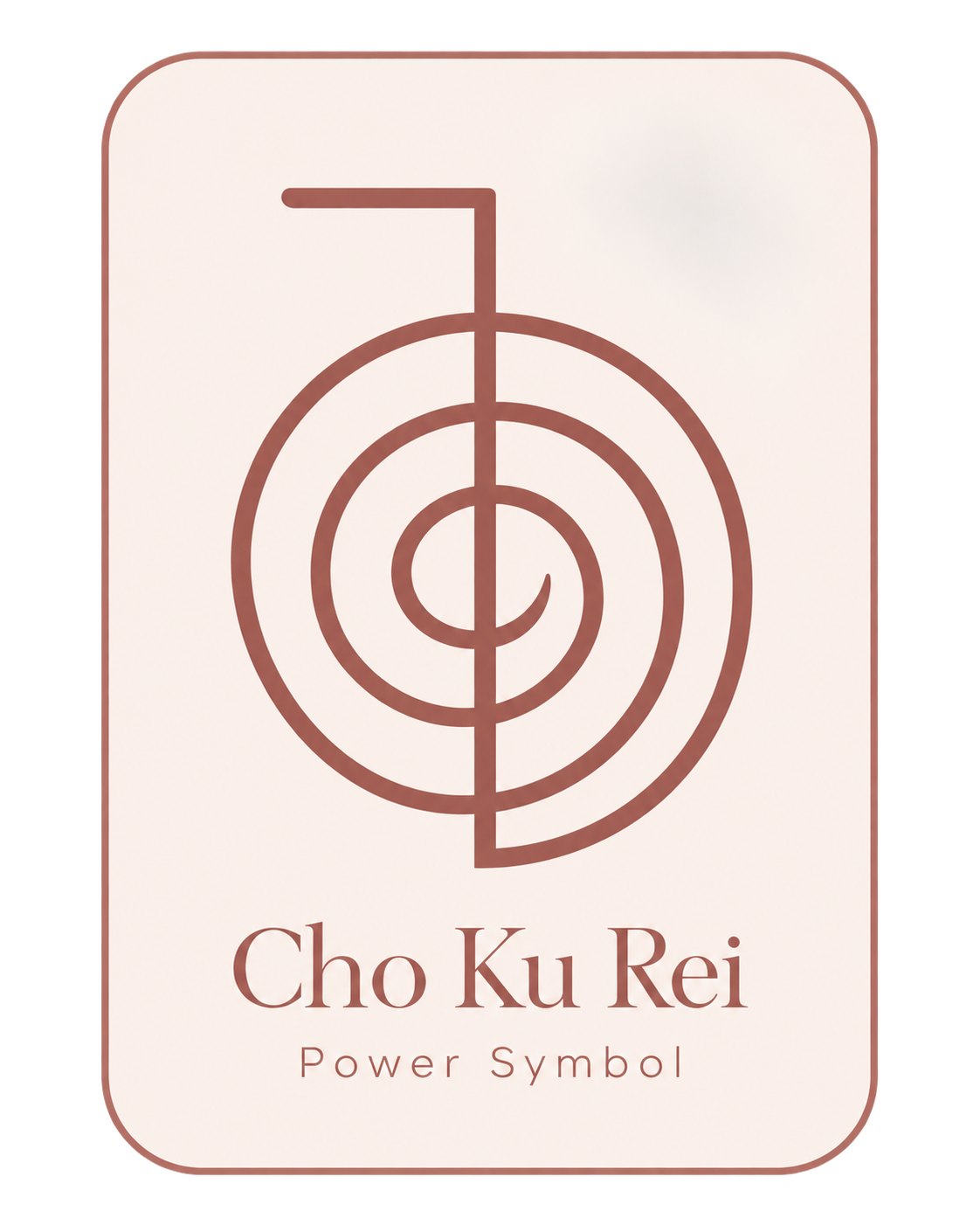
Cho Ku Rei is commonly used to focus or strengthen intention in Reiki practice. Many practitioners associate it with grounding, protection, clearing and bringing attention to a particular area.
- Common association: focus, strength, grounding and energetic protection.
- Often used for: beginning or closing a practice, focusing attention, or working with a specific area.
- Traditional shorthand: often called the Reiki “Power Symbol.”
2. Sei He Ki — the Mental-Emotional Symbol
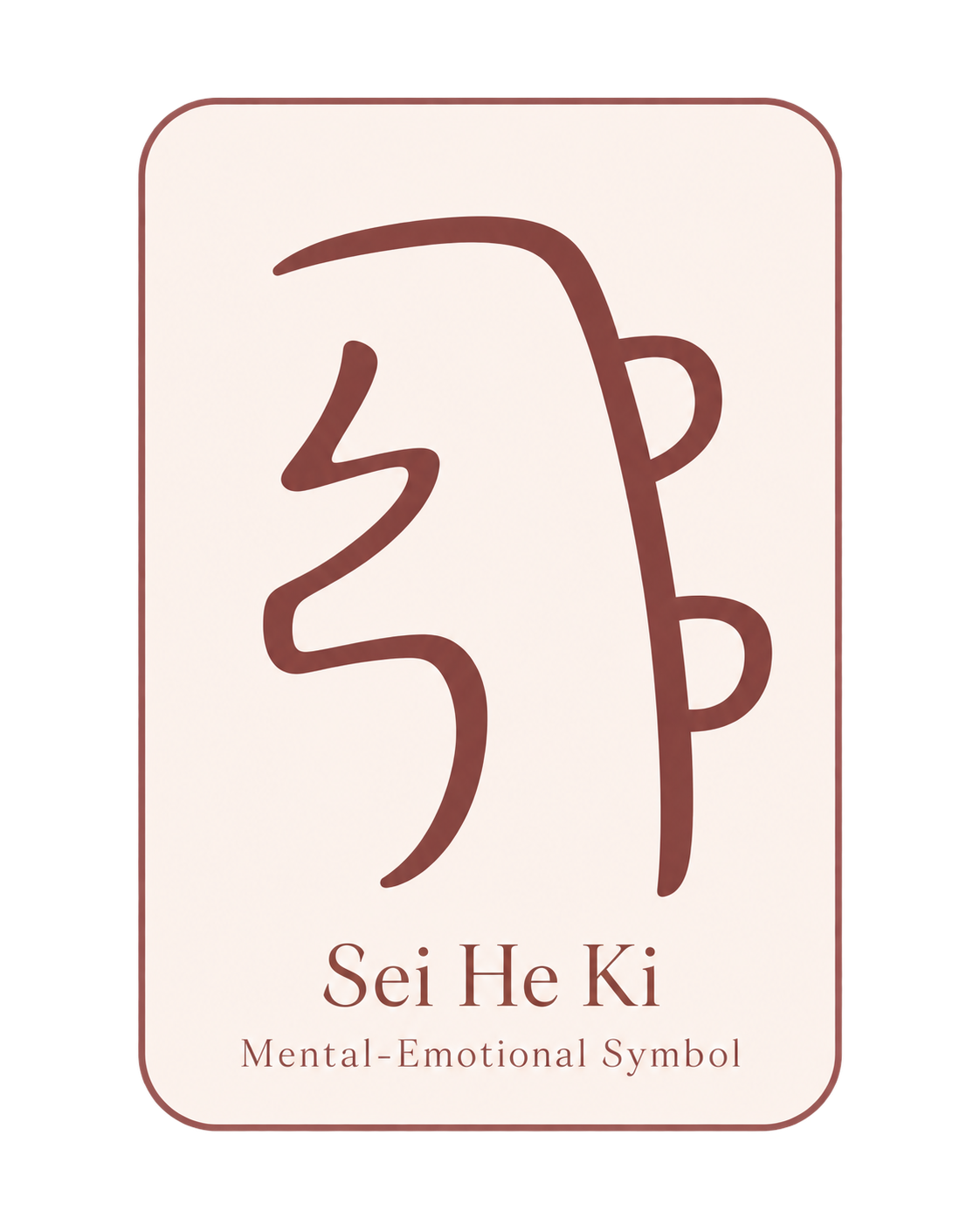
Sei He Ki is traditionally associated with mental and emotional balance. In Reiki teaching, it is often used when the intention of a practice relates to emotions, habits, memories or inner harmony.
- Common association: emotional balance, mental clarity and harmony.
- Often used for: emotional support, self-reflection and calming practices.
- Traditional shorthand: often called the Mental-Emotional Symbol.
3. Hon Sha Ze Sho Nen — the Distance Symbol
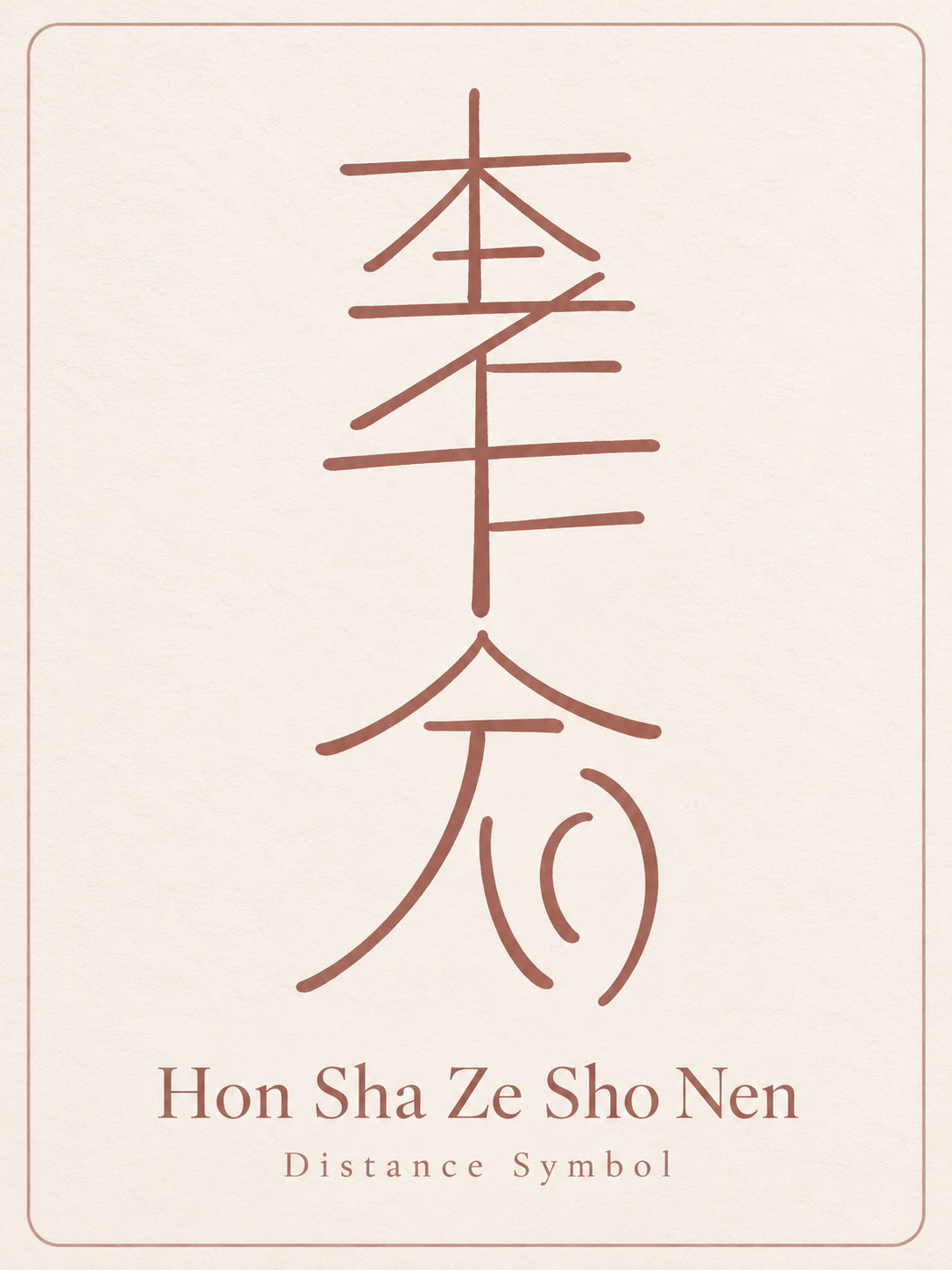
Hon Sha Ze Sho Nen is the symbol most often associated with distance Reiki. Traditional Reiki teachings use it as a way of focusing intention beyond the immediate physical setting.
- Common association: connection across distance and, in some lineages, across time.
- Often used for: distance Reiki and practices involving past situations or future intentions.
- Traditional shorthand: often called the Distance Symbol.
4. Dai Ko Myo — the Master Symbol
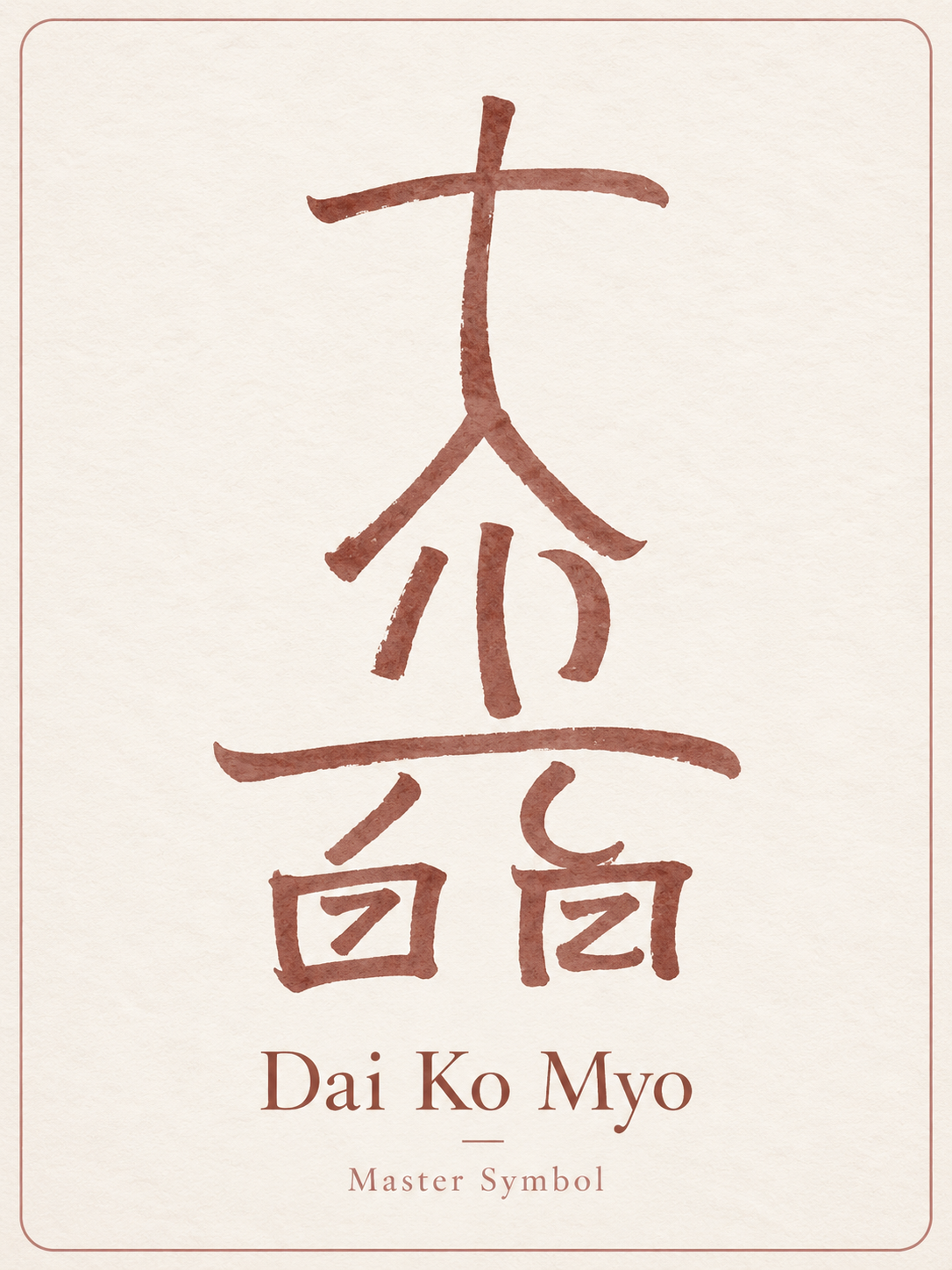
Dai Ko Myo is commonly taught at Reiki Master level. It is associated with the deeper spiritual dimension of Reiki practice, Master-level training and, in many lineages, attunement or initiation work.
- Common association: Master practice, spiritual development and wholeness.
- Often used for: Master-level self-practice, teaching and attunement traditions.
- Traditional shorthand: commonly called the Master Symbol.
Reiki symbols compared
| Symbol | Common name | Traditional association |
|---|---|---|
| Cho Ku Rei | Power Symbol | Focus, grounding, strength |
| Sei He Ki | Mental-Emotional Symbol | Emotional and mental harmony |
| Hon Sha Ze Sho Nen | Distance Symbol | Distance practice and connection |
| Dai Ko Myo | Master Symbol | Master practice and spiritual development |
Where do Reiki symbols come from?
Reiki developed in Japan through the work of Mikao Usui in the early twentieth century. The way the symbols are explained today comes through later teaching lineages, and accounts of their exact origins can differ.
That matters because some popular Reiki histories present a single, very certain story about how the symbols appeared. The historical record is more complicated. Reiki was transmitted through teachers, students and lineages, and parts of its early history were preserved through memorial inscriptions, oral teaching and later accounts rather than detailed contemporary documentation.
For that reason, I prefer to distinguish between Reiki tradition and what can be stated historically with confidence. In practice, the symbols are best understood in the context of the lineage and level in which they are taught.
How I understand the Reiki symbols
In my own practice, I do not experience the symbols simply as shapes or visual instructions. I see them as concentrated points of intention.
These symbols have been contemplated, taught and worked with through generations of Reiki practice. For me, that repeated attention matters. When a symbol is invoked deliberately, it can act almost like a doorway — helping the practitioner move quickly into a particular quality of awareness, intention or connection.
I think of it in the same way that a word, prayer, mantra or piece of music can acquire meaning through repeated use. The physical lines of the symbol are only one part of it. What matters is the intention, attention and relationship that has developed around it.
This is also why I believe Reiki symbols are best learned experientially rather than treated as diagrams to copy from the internet. Their meaning becomes clearer through meditation, practice and the way they are integrated into a Reiki lineage.
Symbols, meditation and focused intention
The specific symbols used in modern Usui Reiki belong to a practice that developed in Japan in the early twentieth century, so I would not describe the Reiki symbols themselves as being hundreds of years old. But the wider idea of using sacred forms, mantra, visualisation and focused intention in contemplative practice is much older and appears across Japanese Buddhist and other spiritual traditions.
That broader context is meaningful to me. Repetition can deepen association. A symbol that is repeatedly contemplated, invoked and connected with a particular intention can become a powerful focal point within a practitioner's inner practice. I see the Reiki symbols in that spirit: not as decorative marks, but as doorways into a more deliberate state of attention.
What does research say about Reiki?
Research into Reiki is still developing, but a growing number of clinical studies and reviews have reported promising results in areas such as anxiety, pain, relaxation and quality of life.
A 2024 meta-analysis involving adults found that Reiki was associated with a significant reduction in anxiety across the included studies. A 2025 meta-analysis of randomised controlled trials also reported a statistically significant improvement in quality-of-life measures following Reiki.
More recent research has explored Reiki in clinical and perioperative settings, with some studies reporting reductions in postoperative pain, anxiety and physiological stress. Reviews involving cancer and palliative-care populations have also reported improvements in areas such as pain, fatigue, relaxation, emotional wellbeing and quality of life in some studies.
The research base is still smaller and less consistent than it is for many conventional treatments, so Reiki is best understood as a complementary wellbeing practice rather than a replacement for medical care. What the emerging evidence does suggest is that the experience of Reiki may support relaxation, comfort and wellbeing for some people.
It is also worth separating research on Reiki sessions as a whole from claims about individual symbols. Current studies do not establish that a particular Reiki symbol produces a specific measurable health outcome. On this page, I am describing the symbols through their traditional role within Reiki practice and through my own experience as a practitioner and teacher.
Research references: 2024 meta-analysis on Reiki and anxiety; 2025 meta-analysis on quality of life.
Can anyone use Reiki symbols?
You can learn about Reiki symbols without being a practitioner. Traditionally, however, their practical use is taught within Reiki training rather than simply copied from an image online.
In many Usui Reiki systems, Cho Ku Rei, Sei He Ki and Hon Sha Ze Sho Nen are introduced at Level 2, while Dai Ko Myo is taught at Master level. The exact sequence can vary by lineage.
Are Reiki symbols secret?
Historically, many Reiki teachers treated the symbols as private teaching material shared during training. Today they are widely published, but some practitioners still choose to approach them with the same respect and context in which they were taught.
How are Reiki symbols used in a session?
A practitioner may visualise or mentally invoke a symbol before or during a session, depending on their training and intention. The client does not need to know the symbols, memorise them, or believe in them for a session to take place.
The practical experience of an in-person session remains simple: you stay fully clothed, rest comfortably, and the practitioner works with hands lightly placed on or held just above the body according to your preferences.
Frequently asked questions about Reiki symbols
How many Reiki symbols are there?
Four symbols are commonly discussed in Usui Reiki: Cho Ku Rei, Sei He Ki, Hon Sha Ze Sho Nen and Dai Ko Myo. Additional symbols may appear in other Reiki systems and later lineages.
What is the Reiki power symbol?
Cho Ku Rei is commonly known as the Reiki Power Symbol and is traditionally associated with focus, grounding and strengthening intention.
What is the Reiki distance symbol?
Hon Sha Ze Sho Nen is commonly called the Distance Symbol and is traditionally used in distance Reiki practice.
Which Reiki symbol is used for emotional healing?
Sei He Ki is the symbol most commonly associated with mental-emotional balance in Reiki teaching.
What is the Reiki Master symbol?
Dai Ko Myo is commonly known as the Master Symbol and is generally taught at Reiki Master level.
Learning the symbols in context
Symbols make more sense when they are learned as part of an actual Reiki practice — alongside hand positions, self-treatment, ethics, lineage, attunement traditions and supervised practice.
If you are exploring Reiki beyond receiving sessions, you can read more about Reiki training. If you are simply curious about what receiving Reiki feels like, start with in-person Reiki sessions.
Explore Reiki in practice
Private in-person Reiki sessions for women are available in Mitcham, Melbourne, and Reiki training is available for those who want to learn the practice more deeply.